Friday, April 12, 2013

Grape Variety Report - Nebbiolo


Where Nebbiolo is grown and grapes on a vine

Nebbiolo is a red Italian grape that predominately makes Barolo, Barbaresco, Gattinara, and Ghemme wine. The grape’s name comes from the Italian word “nebbia” which means “fog”. There are a few explanations to whereas this name may have come from. The grapes are usually harvested in late October, and a very dense fog sets into the Langhe region during harvest. Also, it could refer to the “fog-like” milky covering that forms over the grapes as they reach maturity.
            Nebbiolo grapes produce lightly colored red wines, which take on a brick-orange hue as they age and is an extremely notable characteristic of Nebbiolo wines. These wines can also be highly tannic, with scents of tar and roses, in the earlier stages of aging. As they age, they reveal other scents and flavors such as violets, tar, wild herbs, cherries, earthy, roses, wild cherries, plums, raspberries, truffles, tobacco, and prunes. They also have high acidity. The skins are also thin, but quite tough and fairly resistant to molds and pests. These wines can also take many years of aging to balance the high tannins that these grapes have in their youth. 
Nebbiolo grapes

            Nebbiolo is most notably associated with the Piedmont region in Italy, which is in the northwestern part of the country. Although, it is not the most widely grown grape in Piedmont.
There are around 5,100 hectares of Nebbiolo producing 3.3 million gallons of wine, which sounds like a lot, but actually only accounts for a little over 3% of Piedmont’s entire production! In comparison, there is about 15 times the amount of Barbera as Nebbiolo in Piedmont. Nebbiolo is also grown in the Val d’Aosta region, Valtellina, and Franciacorta.
Piedmont and where Nibbolo is found

            Outside of Italy, the United States is also producing the Nebbiolo grape. California, Washington, and Oregon are the top producing states, with the Northern Region of Baja California, Mexico having over 1,100 hectares of the Nebbiolo grape. Argentina has a small amount of the grape, with 81 hectares. There’s a small amount in Australia as well in the region of Victoria.
Nebbiolo thrives best in continental climates, which are characterized by the very marked season changes that occur throughout the growing seasons. For example, hot temperatures during the summer season and temperatures occasionally below freezing in the winter. Although, these conditions cause some viticulture hazards such as frost and hail. The reason Nebbiolo thrives so well in the Piedmont region is due in part to the continental climate and the Tanaro River that produces a lot of water for the inland region. A lot of the soil here is dominated by sand and limestone, with some clay deposits that add to the tannic structure. 
Vineyard with an area specifically for Barolo wines

            In the Piedmont region the Nebbiolo grape is used for Barolo and Barbaresco wines and other DOCG regulated wines. These wines have relatively high alcohol content (12.5%-13%) and are aged in oak for a specific amount of years dictated by the DOCG. They produce powerful concentrated wines that are very full bodied, and have a perfume scent and a silky texture. Ghemme and Gattinara wines in the Novara and Vercelli hills of Piedmont are also made of the Nebbiolo grape. These wines tend to be lighter, earthier wines. These producers in this part of the region are allowed to blend a small percentage of Bonarda, Croatina, and Vespolina into their Nebbiolo wines. The cooler climate in the northern part of the region produces wines with a lot of perfume scents. Wines produced in nearby Alba tend to have more complexity and body, while wines produced in Roero, which is also close to the Tanaro River, tend to be less tannic and lighter. Alba has been known to have the best Nebbiolo wines. Finally, outside of Piedmont, Nebbiolo plantings in Valtellina tend to lack ripeness and can have a very off putting acidic taste to them.
            Nebbiolo is also produced in the United States, specifically in the jug wine producing region of the Central Valley in the California. Although, there has been problems with finding the right soil and area in California to produce high quality Nebbiolo grapes, which is why they’re usually used for jug wines since California wine producers aim for high quality wines.
            Australia has a small amount of plantings of Nebbiolo, but they have found out that the climate in Australia isn’t ideal due to the warmer climate. Although, the Victoria region’s King Valley has a cooler climate and is where Nebbiolo is grown there. They have a small amount of production there.
            Mexico, Chile, and Austria have been experimenting with growing Nebbiolo as well. Although, Mexico has found they have low yielding plants, but with very good color and fine qualities. Chile has produced Nebbiolo with high acidity and poor color, but with extremely high yields, so they are working on different clones that are better suited for their climate. Austria has just begun plantings. 
Nebbiolo from Langhe

            Generally Nebbiolo wines are big, bold, tannic red wines. These wines are paired well with grilled meats and stews and dry, aged cheeses. As stated before, Nebbiolo wines are often aged for a while to balance the tannic structure and to achieve that brick-orange hue around the edge of the wine, and this aging process makes it go well with the cheeses. You could also pair with venison, beef wellington, lamb, ribs, and cheddar cheese.    


Resources
http://www.wineaccess.com/wine/grape/nebbiolo


Friday, April 5, 2013

Grape Varietal Report - Sangiovese


The Sangiovese grape is a red Italian wine grape variety. It gets its name from the latin words sanguis Jovis, which means “the blood of Jove”. It is most notably grown in the Tuscany region in Italy.
Italian wine regions
Tuscany, in green, where Sangiovese is grown

 It is most famous for its use in the Chianti wine blends. It is also used in Carmignano, Vino Nobile di Montepulciano, and Morellino di Scansano blends. It can be used to make varietal wines such as Burnello di Montalcino, Rosso di Montalcino, or Sangiovese di Romagna.
            Its flavor profile significantly consists of fruity flavors, especially strawberry and a slightly spiciness. Other fruits used to describe wines with Sangiovese would be black cherries, red plums, and blueberries. It also can have a few floral notes, especially violet. The spiciness of Sangiovese can also sometimes be described as a cinnamon smell. Although, when the wine is aged in oak barrels, it can be described as oaky or even tarry if in the barrel for too long or simply not in the barrel correctly. It is very prone to being overwhelmed by other flavors.
            Sangiovese wines are generally best consumed within two to four years of its harvest.
            Sangiovese is grown world-wide, but as mentioned earlier; it is most notably grown in Italy, especially in the Tuscany region. It can be found in other areas of Italy such as the Romagna region. It is also notably grown in the United States, Australia, South and Central America, and some parts of South Africa as well.
It can be grown all over the world due to its viticulture. It is adaptable to many types of soil, but seems to do best in soils with a high concentration of limestone. Although, in the Chianti region, Sangiovese thrives on the highly friable shale-clay soil known as galestro.
            This grape also requires a sufficient amount of warmth to ripen fully so it needs to be in areas that stay warmer for longer periods of time, which is why most of the areas that grow Sangiovese have long summers. Although, these grapes are very prone to rot if in the sun too long. Also, due to the grape’s thin skin, it is also prone to rot in the middle part of autumn with a lot of rainfall.  
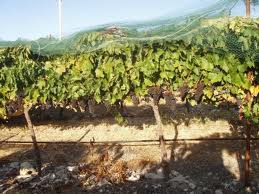
Sangiovese on the vine
  
Sangiovese has a lot of clonal variations. At least fourteen different variations exist today.
            The sangiovese grape is also very prone to overproduction due to its vigorous growing along the vine. Although, if you decide to try and curb this by planting vines in high densities to stop this, the vines will actually block the sunlight and the grapes won’t get enough light. The ideal yield for Sangiovese grapes is 3 pounds of fruit per vine. 
Sangiovese foliage

            A problem Sangiovese also has is that if it has a high-yielding vine, the wine tends to be lighter, highly acidic, but with less alcohol. This causes the wine to easily oxidize prematurely which also results in a lower concentration of tannins and anti-oxidants. Ideally with Sangiovese you want to keep a “smaller” amount of plants because of the way it vigorously grows.
            Sangiovese accounts for approximately 10% of all vineyard plantings in Italy, with more than 100,000 hectares of clonal variations. Tuscany has over 63,000 hectares of Sangiovese currently. Argentina has 2,800 hectares, Romania has 1,700 hectares, Corsica region in France has 1,663 hectares, and California has 1,371 hectares and Australia with 1,087 hectares. All in all, Sangiovese is grown mainly in Italy and is the pride and joy of the Tuscany region, where they also make Chianti wine out of the Sangiovese grape.
            Chianti wine is a stout bottle that’s in a straw basket and is made out of the Sangiovese grape, or at least 70%. These wines were the general basis idea that jug wines came from. Now days, Chianti wine is bottled in just regular bottles.
            Due to its flavor profile, Sangiovese should be paired with rare steaks, roasted game birds, rich chicken, mushroom dishes, or anything with tomato sauce. It’s vibrant acidity and substantial tannins really help bring out the flavors in these foods. These foods also help bring out the cherry taste and herbal scents in the wine. One of the most notable pairings as well would be a bottle of Chianti with a plate of spaghetti. 
Banfi Chianti Classico Riserva 2008

Although, this is not always the best pairing for Sangiovese grapes because sometimes the tomato can clash with the acidity of the grape. To be on the safe side, pair with red meats, wild game, and roasted vegetables with herbs.
            In Tuscany, Sangiovese is the only grape variety that is permitted in the Brunello di Montalcino DOCG. Furthermore, in Italy most “wine snobs” also consider Sangiovese to be the prominent grape necessary for Vino Nobile di Montepulciano. The Italians take the Sangiovese grape very seriously. 

Resources


Tasting - Ruta 22 Malbec


Name: Ruta 22 Malbec
Variety: Malbec
Region: Patagonia
Country: Argentina
Year: 2011
Price: $7.95
Shop review: Stout and dense from the beginning, with blackberry and violet aromas. Despite being a bold and dark Malbec, this is fresh and composed, with sweet blackberry and cassis flavors. Good on the finish, with candied fruit and caramel sweetness.
My review: Upon smelling it smelled a lot like blackberry jam, very sweet and pungent (in a good way). I got a slight hint of caramel as well. It tasted super dry on the finish, and it had a dark flavor that I can't really place. It was almost like coffee in that it had a slight bitterness on my tongue, and it had a dark smoky finish. I wasn't very fond of this wine. I tried it on its own without food.

Tasting - Chateau Serres Sainte Lucie Corbieres


Name: Chateau Serres Sainte Lucie Corbieres
Variety: Syrah, Grenache, and Mourvedre
Region: Corbieres
Country: France
Year: 2010
Price: $4.95
Shop review: Superb dark garnet color with a few reflections of dark orange. Intense nose of ripe fruits, spices, and roasted coffee. The palate is rounded and full, with silky matured tannins and hints of vanilla. This wine is rich and powerful with layers of tannins.
My review: It smelled really spicy at first! I got a hint of vanilla on the nose as well. Upon tasting it had the most interesting texture I've noticed on a wine, and it was really silky on my tongue. It tasted a lot like blackberries and wasn't nearly as spicy as I anticipated from the smell, but it was a little grainy from the tannins. On the finish it was dry and bitter, with a slight vanilla end. I tried this on its own without food.

Tasting - Cresta Azul


Name: Cresta Azul
Variety: Blend of Moscatel, Macabeo, Parellada, Xarel-lo
Region: Catalunya
Country: Spain
Year: Non Vintage
Price: $5.95
Shop review: Peach, orange cream, and vanilla flavors mingle in this softly bubbly white. Off-dry, but with crisp acidity and a clean finish.
My review: I loved this wine and ended up buying it actually! It smelled immediately like an orange dreamsicle since I really like those. It was also super peachy smelling. Upon tasting it was slightly sweet with a small hint of bubbles, and I got a mixture of pears, peaches, and apples. The finish was slightly dry, and left a slightly sticky taste in my mouth that I really liked! I tried this wine on its own without food, but I plan to try it with food!

Tasting - Veleta Tempranillo Rosado


Name: Veleta Tempranillo Rosado
Variety: Tempranillo
Region: Granada
Country: Spain
Year: 2010
Price: $3.95
Shop review: Fresh in flavor and crisp in texture, this dry rose offers berry, tart cherry and light herbal flavors, with firm acidity and a clean finish. Focused and juicy.
My review: This smelled extremely floral to me. It honestly smelled slightly like laundry to me to on the nose. Upon tasting it was much better than it smelled, slightly sweet with a nice cherry hint, but not like cough medicine or anything. It had a dry finish where I could taste a little raspberry and I liked this wine. I tried it on its own without food.

Tasting - Veleta Brut Vino Espumoso Rosado


Name: Veleta Brut Vino Espumoso Rosado
Variety: Sparkling Brut Blend
Region: Granada
Country: Spain
Year: NV
Price: $3.95
Shop review: Rose salmon with copper reflections. Slow rising fine bubble that forms "lace" and "rosary". In the nose is complex and elegant with red fruit, citric, exotic, fresh flowers, and notes of dry fruits and dry flowers. Fresh, gentle, and alive. Perfectly integrated "perlage" with serious and subtle flavors of dry fruits, pomegranate, and lemonade. Long lasting scent of flowers and herbs.
My review: This smelled distinctly like vinegar to me. It had a weird almost rotting smell, and when I initially smelled it it literally made my knees weak it smelled so weird. Upon tasting it kind of tasted like a rose champagne but a little lemony and a little bit of the rotting smell kind of made it taste rotting a little to me. I'm not really sure what it actually tasted like because the smell kind of ruined it for me. I tried this one its own without food. I will not be tasting this again.